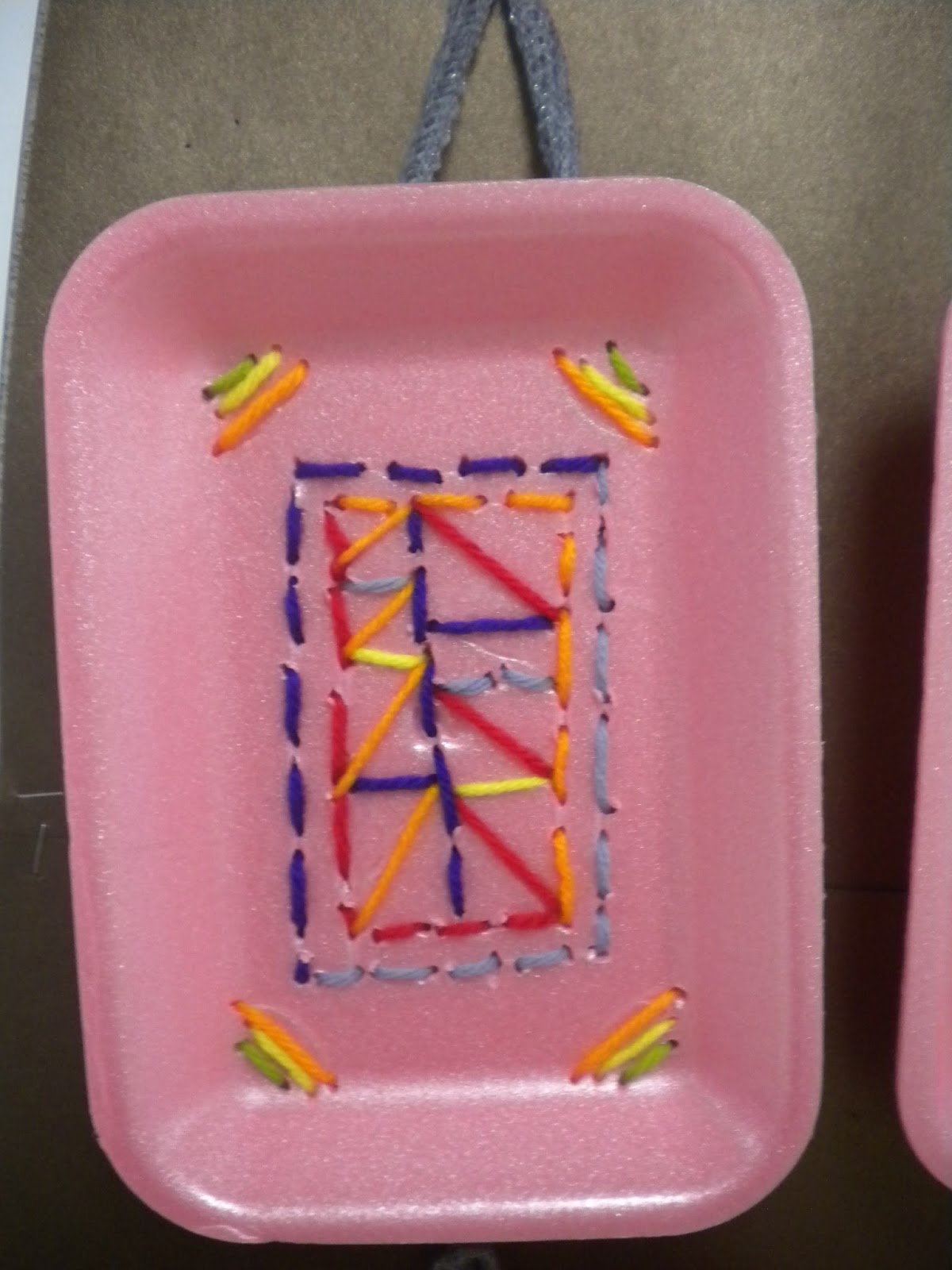
"Mama"

"Mama"
"Mama" by my daughter age 3

Thursday, January 7, 2016

Plushie Angry Birds


5th graders learned about the artist Claes Oldenburg through a Power Point presentation. Since 1962, Oldenburg has been making soft sculpture based on common objects ranging from household fixtures (such as toilets, fans, and light switches) to even food. Students also reviewed the art movement, POP ART. Pop art can be any every day item, also. Pop Art is short for Popular Art. It is inspired by comic strips, advertising, and popular entertainment…things that you would see in everyday life.

When deciding what students should create for their soft sculptures, I looked to what’s popular in their culture right now- ANGRY BIRDS! Students first created an Angry Bird drawing, they had a choice of 3 templates to trace, but were responsible for adding all the details in the face and body. They outlined in Sharpie, colored in, and cut it out. This would later be used as a guide for when they were adding details to their soft sculptures.

For their sculptures students used their drawing as a tracer, and traced it onto two pieces of felt, then cut it out. Students learned how to sew using two types of stitches in their sculpture- a straight stitch and a whip stitch. When their sculpture was about ¾ of the way sewn shut, they stuffed it with cotton batting to make their sculptures fluffy, like Oldenburg’s sculptures.

Students then cut shapes from felt scraps to create their Angry Birds face, and used tacky glue to glue pieces to the body. All the student’s did a phenomenal job on this project! They were engaged the entire time we were working on this, and I had several students who came in on their own time to work on it. It was great to see them so inspired and working so hard!

**Lesson idea from Art with Mrs. Nguyen**  
http://www.artwithmrsnguyen.com/2012/11/pop-art-plushies-5th.html 
Thank you! my students love this project, I've done it several times now.


Snowmen


Painted Snowmen


First graders read the story The Ten Days of Winter by Denise Flemming. We then did a pencil drawing of a snowman profile. (Profile means a portrait viewed from the side). Next we discussed what texture and visual texture is. Texture is how something feels. Visual texture is what artists use to make something look like it is bumpy, but it really is not. Students created visual texture on the background of their art by using chalk and texture rubbing plates. Then they painted in their snowman using sponge brushes, again creating visual texture. Next they painted the details of their snowman and painted snowflakes in the background.

Chinese Dragons


Third graders learned about Chinese dragons through a Power Point presentation in art class. They learned that today, we know that magical dragons exist only in imagination and myth.  They are mythical creatures. But in ancient China, the people firmly believed that dragons were real and powerful. The dragon was the sign of the emperors. Legend says that there were 5 different type of Chinese dragons: Wood, Fire, Earth, Water, and Metal.

Third graders were working on their effort and craftsmanship for this art project. Students started out by using yarn to make the dragon’s body. Then, they used colored pencils to add a head and tail, and patterns around the string for the body. They reviewed that a pattern must repeat itself in order for it to be a pattern.

Students took their time in creating a simple, yet neat and detailed Chinese Dragon.


Quilts of Gee's Bend


Mouse Paint


For my SLO (part of Educator Effectiveness), my goal is to have second graders able to identify the primary colors and know which primary colors when mixed together create the secondary colors.Students took a baseline test of color mixing so I could know how much they knew before the color mixing lesson. After the baseline test we did a Smart Board activity to reveal which primaries when mixed together make the secondaries. We then read the book Mouse Paint.  For the project students used primary water colors to mix the secondaries for their backgrounds. They then made three mice from construction paper. It was a quick and easy color mixing lesson:)

Wednesday, December 9, 2015

Clay Pout Pout Fish


2nd Graders read the story the Pout Pout Fish. We then made a stencil drawing of a Pout Pout Fish on manilla railroad board paper. Students cut it and had a tracer for their slab fish. We reviewed clay vocabulary, slab, score, and slip. We also discussed what texture meant, both actual and visual texture. Students rolled out their slab of clay, traced their fish shape on it and used cutting tools to cut it out. Students then used stamps and a drawing tool to create texture and details on their fish. From their left over slab they created the eyes, mouth and fin and used proper attaching techniques. Lastly, they glazed using Magic Glazes. Easy clay in a day project that goes over beginning techniques and vocabulary.

Tuesday, December 1, 2015

Guitars


4th graders learned about the city of Paracho, Mexico; a city located just 2 hours south of Guadalajara. The interesting thing about the city of Paracho is that it is said to have more guitar-making artisans within its population of approximately 17,000 people, than in the entire United States!

Guitar making is a tradition passed down from generation to generation and is a source of income for the people of Paracho. The guitar-making also attracts a bit of tourism for the city as it hosts a Guitar Festival each year.


Students learned about the parts of a guitar through Smart Board matching game. Next they reviewed the warm and cool colors of the color wheel. Students choose one color scheme and sponge painted their paper with those colors. They then used the opposite color scheme to add the details of the guitar.

***Wonderful lesson and background info from Art with Mrs. Nguyen blog***

Pattern Harvest Corn


I really try to work on the basic fine art motor skills and knowledge in First Grade. A lot of the projects might seem very basic, but our kindergartners do not have art class in our district. So a lot of the time I get first graders coming in who don't know much about how to use a scissor properly, or glue correctly, or even how to hold a paintbrush. This lesson was a bit of review and also new information. I also focus quite a bit on proper art vocabulary. No hamburger or hot dog folds in my art class, we say vertical and horizontal. Students first looked at real harvest corn and we discussed what types of lines we saw and any colors that repeated. First we drew the shape of our corn using curved lines and vertical lines. Next we used three fingers to measure our horizontal lines going across so that they would be somewhat evenly spaced out. We outlined our drawing in Sharpie. Next we talked about pattern. I always tell my students the key to making a pattern is that it has to REPEAT! I give them tons of examples and then always let them complete the pattern. I even make a pattern out of the class using a boy/girl pattern. Someone always figures it out and they love that. Students choose 2-5 colors to make a pattern on their Harvest corn. Paper towels were ripped, twisted and glued on for the stalks.