"Mama"

"Mama"
"Mama" by my daughter age 3

Tuesday, February 19, 2013

Jelly Fish Paintings


First Graders learned all about jelly fish through a Power Point Presentation and watched a video of all different types of jelly fish in the ocean. They learned that jelly fish have no brains, have tentacles, eat small fish, and can sting as a defense mechanism. They also learned that jelly fish are made of 95% water, so it would be really hard to pick up a jelly fish! Of course they observed with their art eyes all the different shapes and colors that jelly fish can be.


For their art project, they first painted the ocean using only the cool colors. Next they added ocean floor details using oil pastels. They cut out the jelly fish from tissue paper, because tissue paper is fragile, like a jelly fish! For some finishing touches, they added glitter gloss to the jellies for some shimmer, and used circle stamps to create bubbles.

Bubble Gum Self Portraits


*Idea seen on Pinterest:)

Roy Lichtenstein ONOMATOPOEIA Art


4th graders learned about the artist Roy Lichtenstein by viewing a Power Point of his artwork and history. They also learned about onomatopoeias and how they are used. They also viewed an old school Batman and Robin clip from the original series where onomatopoeias are used during the fight  scense (disclaimer: we do not promote fighting in anyway and I made sure to tell the students that, and that it was all pretend:) For their project they choose two of the three primary colors and did symmetrical cutouts. These were then glued to white paper where they added black dots, like the benday dots Lichtenstien used. They then choose their onomatopoeia word, traced it with stencils and colored it in with whatever primary color they hadn't used yet. Lastly, they added some star shapes with motion lines for an extra detail.

Underwater Paper Sculptures


1st and 2nd graders learned about the difference between 2d and 3d art. We learned that you can make sculptures from paper as well. We discussed how to create symmetry when cutting on the folder side of a piece of paper. Students made their water by drawing wavy lines on a folded piece of cardstock and then cutting. We read the story THE POUT POUT FISH. The story was a great addition to the lesson because the Pout Pout fish met many different types of sea creatures throughout the story. Students then had to draw and cut out 6 sea creatures from our scrap paper box and then add details using marker and glue it on the water.  Lastly they made a sail boat from construction paper and a craft stick to float on the surface of the water. They turned out awesome!

Thursday, January 17, 2013

Collage Fishies


3rd graders watched a video of underwater sea creatures. They used their art eyes to observe all the colors, shapes, patterns, and different species that were shown in the ocean. We discussed how fish can have multiple colors. For their project they made their own paper using tissue paper and paper mache glue. They choose 2 or 3 colors for their fish, and added a little bit of tinfoil for some shine. They folded their papers in half and drew half their fish on the fold. Once cut and they opened it up, they had a symmetrical fish. They created the scales by folding their fish in half again, and cut just a little bit. Then they bent out every other fold. They turned out beautiful‼! This has been my favorite project so far this year!
(*Lesson taken from A Faithful Attempt Blog*) 

Visual Movement


4th graders reviewed the art term LINE and learned about VISUAL MOVEMENT in artwork. Visual movement is how your eye moves across an artwork when viewing it. Artists use several elements to create movement: line, shape, and color are some of the main ways and this is what the 4th graders discussed in class. 4th graders created an artwork with lots of visual movement in it. First they created movement by drawing wavy lines on their paper. They second way they created movement was by coloring in each section with a different color. And the last way they created movement was by writing words in the spaces. They wrote our school's expectations, plus two adjectives to describe themselves.

Adaptive Jellyfish


Adaptive students learned all sorts of facts about jellyfish. We also watched a short video to see all the different types of jellyfish there are.
(*idea originated from Relentlessly fun, Deceptively Educational blog)

Winter Trees


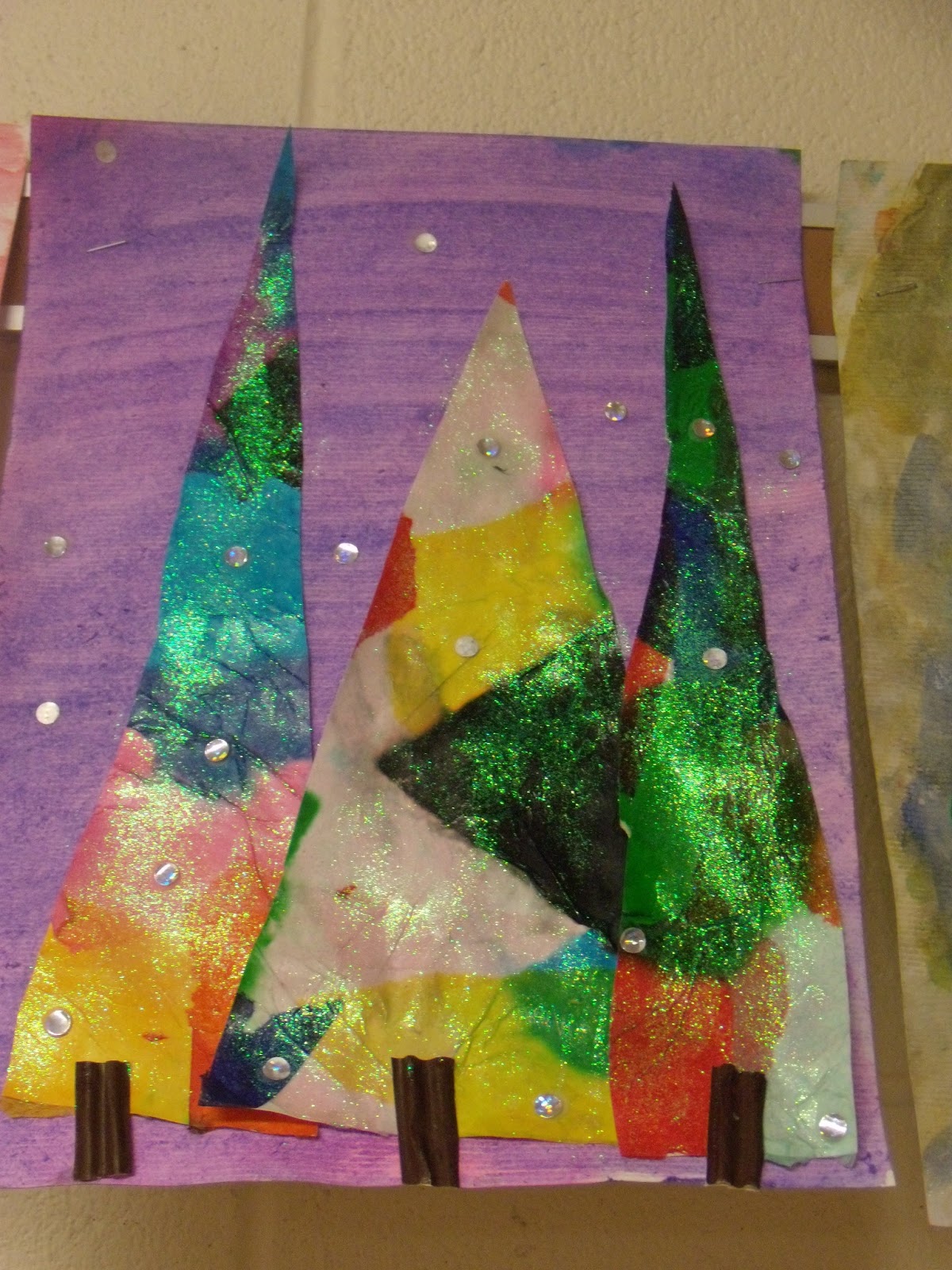
First graders made their own paper for their winter trees using tissue paper and paper mache glue. They could use as many colors as they wanted (these are art  winter trees after all;) They then painted a water color background using two colors. Once the papers were dry they cut three tall triangles on their handmade paper. They had to draw It just right to make sure all three triangles fit. They cut and glued the trees on the painted background. They added tree trunks using crinkly brown paper. Lastly, they added glitter gloss to the trees for some winter sparkle, and used paper hole punches to cut snowflakes from silver paper. They did a great job creating an artistic winter wonderland!

Reindeer


Cute winter project. First graders first sponge painted their background using metallic paints. Next they drew and cut out the head and body of their reindeer from brown paper. I had precut strips for the legs, those were folded with an accordion fold and glued on. Next the antlers and nose were made from corrugated paper. Trees cut, smaller ones glued in the back, larger ones glued in the front. And we used a cardboard strip to stamp the snowflakes and snow on the trees.

Fish Paper Sculpture


I've been doing an underwater unit with most of my classes since returning from winter break. I've been doing so much 3d art with my fifth graders, I though we'd combine 3d and 2d for their first underwater project. I checked out tons of books on fish and sea creatures from our library. I also showed a short video of some amazing underwater footage of all sorts of different sea creatures. I told them to be very observant of the art elements that they are seeing in the fish. Each student was required to draw two fish on their choice of colored construction paper. They needed to draw lots of details, but keep the coloring to a minimum since we were using colored construction paper. Once their fish were drawn and colored, they created the paper waves from two shades of blue and attached the fish with some glue and staple here and there to secure it for good measure.

(*The idea for this started on a photograph I saw on Mr. E's art blog*)